
A dutiful desire to “help represent the East” in the third annual parade of the League had caused me to sojourn in Chicago for the last three days of spring, during which I made trial of its streets and park-roads to the extent of 75 m.; and then I took train for Cincinnati, in company with the club-men of that city returning from the parade, in which their new uniforms of green velveteen had played so picturesque a part. None of the numerous bicyclers from various localities whom I talked with in Chicago had planned to prolong their vacations so as to include a little touring after the meet was over; but the representatives of Cincinnati and Louisville all agreed in assuring me that, if I were individually bent on taking a tour, I should act wisely in choosing Kentucky for the scene of it. Some letters with a Frankfort rider had recently contributed to one of the cycling weeklies, in praise of the roads of that State, had first awakened my interest therein; and on finding these praises justified by the verbal reports of several others, whose explorations, though individually short, covered in the aggregate a good many miles of road, I determined to make the Mammoth Cave the objective point of my spring tour. The alternative plan which I had in mind when I went to Chicago was that of riding from Detroit to Niagara along the Canadian side of Lake Erie; and that its practicality has been demonstrated by the July expedition of the Chicago Bicycle Club.
 It was 9 o’clock of a Thursday forenoon, the first forenoon of June,
when I first got astride my bicycle, at the head of the so-called Lexington
turnpike, in the outskirts of
Covington,
about 2 m. from the r. r. station in Cincinnati, whence I had trundled it
along the sidewalks and over the big bridge. After riding 1 m. I stopped
midway on a long hill, which would have been ridable to the summit except
for the recent rain, and took a look backward at the smoky city below me.
Erlanger, a railroad station 6 m. on, was reached at 11 o’clock; and
it is enshrined in my memory as the spot where a German servant-girl,
observing me oiling the wheel, came out to inquire if I would grind a pair
of scissors for her mistress. For 2 m. beyond this point, or to the village
of
Florence,
the mud continued to give occasional trouble; but dryness thenceforth
prevailed, and the road averaged better as to both smoothness and hardness,
so that in the next 1 ½ h. I covered the 9 m., ending at a wretched
little inn at
Walton,
where I stopped for lunch. Beyond was
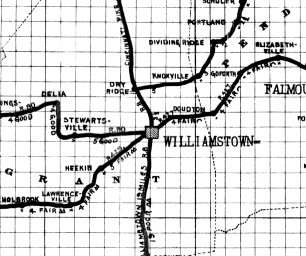
Williamstown,
the county-seat, 18 m., and there I rested for the night, at the Campbell
House, whose accommodations, though very inferior, were said to be by no
means as bad as those offered by its rival, the Sherman. I arrived at 6
o’clock, having been 2 ½ h. in doing the last 13 m. from
Chittenden; and the cyclometer’s record for the whole distance from
the r. r. station in Cincinnati was 39 m. “Pike” is the only
word used in Kentucky to designate a macadamized highway or turnpike; and
the Lexington pike, on which I began my ride through the State, I should
have found to be a very good one had not some sections of it been spoiled
by the railroad men. These people agreed that such parts of the pike as
were needed for their new line should be replaced by a parallel roadway,
just as solidly and smoothly paved as the original; but they failed to keep
their agreement, and the parts of the pike that had been made by them
supplied the poorest riding of the day. During the whole of it I probably
found not a single m. of continuously level surface; but none of the grades
were too steep for riding when well paved. The most striking sign of a
changed civilization, which challenged my attention as I entered the State,
was the number of people on horseback, going about their usual business,
with bundles, bags, baskets, and farming implements, hitched to their
saddles. They seemed to outnumber the people who drove in wagons or
carriages; whereas, in the East, a horseback-rider who is not simply a
pleasure-seeker is a rare bird indeed. I found that these Kentucky steeds,
being only half broken, were more inclined to take fright than any others
known to my experience. So, having inadvertently caused one of them to back
against a fence and break his harness, a few hours after I began my tour, I
generally made of practice of dismounting as they approached me.
It was 9 o’clock of a Thursday forenoon, the first forenoon of June,
when I first got astride my bicycle, at the head of the so-called Lexington
turnpike, in the outskirts of
Covington,
about 2 m. from the r. r. station in Cincinnati, whence I had trundled it
along the sidewalks and over the big bridge. After riding 1 m. I stopped
midway on a long hill, which would have been ridable to the summit except
for the recent rain, and took a look backward at the smoky city below me.
Erlanger, a railroad station 6 m. on, was reached at 11 o’clock; and
it is enshrined in my memory as the spot where a German servant-girl,
observing me oiling the wheel, came out to inquire if I would grind a pair
of scissors for her mistress. For 2 m. beyond this point, or to the village
of
Florence,
the mud continued to give occasional trouble; but dryness thenceforth
prevailed, and the road averaged better as to both smoothness and hardness,
so that in the next 1 ½ h. I covered the 9 m., ending at a wretched
little inn at
Walton,
where I stopped for lunch. Beyond was
Williamstown,
the county-seat, 18 m., and there I rested for the night, at the Campbell
House, whose accommodations, though very inferior, were said to be by no
means as bad as those offered by its rival, the Sherman. I arrived at 6
o’clock, having been 2 ½ h. in doing the last 13 m. from
Chittenden; and the cyclometer’s record for the whole distance from
the r. r. station in Cincinnati was 39 m. “Pike” is the only
word used in Kentucky to designate a macadamized highway or turnpike; and
the Lexington pike, on which I began my ride through the State, I should
have found to be a very good one had not some sections of it been spoiled
by the railroad men. These people agreed that such parts of the pike as
were needed for their new line should be replaced by a parallel roadway,
just as solidly and smoothly paved as the original; but they failed to keep
their agreement, and the parts of the pike that had been made by them
supplied the poorest riding of the day. During the whole of it I probably
found not a single m. of continuously level surface; but none of the grades
were too steep for riding when well paved. The most striking sign of a
changed civilization, which challenged my attention as I entered the State,
was the number of people on horseback, going about their usual business,
with bundles, bags, baskets, and farming implements, hitched to their
saddles. They seemed to outnumber the people who drove in wagons or
carriages; whereas, in the East, a horseback-rider who is not simply a
pleasure-seeker is a rare bird indeed. I found that these Kentucky steeds,
being only half broken, were more inclined to take fright than any others
known to my experience. So, having inadvertently caused one of them to back
against a fence and break his harness, a few hours after I began my tour, I
generally made of practice of dismounting as they approached me.