
 The fifth day of this was the worst one yet known to my four years’
experience as an explorer on the wheel. I awoke that Monday morning with
such a disagreeable reminder of the fried ham which had formed so chief a
part in my last night’s supper that I dared not further outrage my
stomach by attempting a breakfast composed of the same inevitable dish.
Starting off at a quarter of 6, therefore, with only a glass of milk to
sustain me, I rode 5 ½ m. along a smooth pike of gravel (the first
level one thus far encountered) through a manufacturing village, and to a
bridge at the foot of a long ascent. Here, ¾ h. from the start,
ended my good riding for the day; though short mounts were possible for the
next 9 m., which I covered in about 3 h.
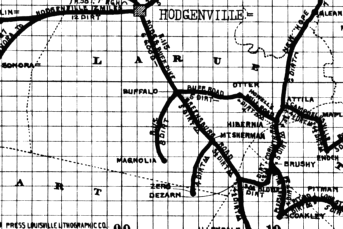
Buffalo
was the name of the village where I then took an hour’s rest, and
sought further nutriment as a substitute for breakfast. Crackers and
cheese, washed down by a mixture of four raw eggs, beaten up with sugar and
water, represented the utmost capacity of the village store as a
restaurant, and the hospitable proprietor thereof refused to accept any
money for the entertainment. But, at the store in Magnolia, 5 m. on, where
noon found me, nothing whatever of an eatable nature was to be procured. I
was 2 h. on the way, and walked nearly all of it, beneath a blazing sun.
The region was rather barren and uninteresting, and two or three small
brooks had to be forded. Soft stretches of sand alternated with rough
sections of limestone, originally laid as a foundation for the long
abandoned pike. I was told that this continued southward to “the
burnt-bridge ferry over Green river.,” 12 m.; then to Canmer, 4 m.,
and then to “Bar Waller” (Bear Wallow), in the neighborhood of
the Cave; and that some parts of it were probably in good condition. I
determined, however, to pin no more hopes to the pike, but to strike
westward, along a “dirt-road,” to the nearest station on the
line of the railway, which same was called
Upton,
and proved to be 11 m. distant. I was 4 h. in getting there, and the only
riding possible was on a few short paths where the dense shade bed kept the
black-clay hard, –perhaps 1 m. in all. With this significant
exception, my course from Magnolia to Upton led continuously up and down
steep ridges of red and yellow clay, without any level interval between
them. If the reader can imagine a field 11 m. wide, which a gigantic plough
has turned over into parallel furrows 50 ft. deep, and can then picture me,
in the blistering sunshine, laboriously lowering my bicycle down the steep
slopes of these furrows and painfully pushing it up the slopes again, until
the last parallel has been crossed, he will gain a pretty good idea of the
nature of my four hours’ fun that afternoon, –though hardly an
adequate idea of the nature of a Kentucky “dirt road.” There
were several brooks which had to be crossed on logs, or stones, or else
forded; but the ruts and gullies of clay which defined the road were quite
dry. After a few hours’ rain, those ruts and gullies would be
transformed into a slough which no man could drag himself through, unless
he were naked, to say nothing of dragging a bicycle. A supper of bread and
milk at 6 o’clock, as a sequel to a bath and assumption of dry
clothes at Upton, completes the record of all the food I ate on that
tiresome day. A thunder-shower cooled the air somewhat before I look train,
1 h. later, and rode 25 m. to the hotel at
Cave City,
which city consists almost entirely of the hotel, and the hotel embraces
the railroad station.
The fifth day of this was the worst one yet known to my four years’
experience as an explorer on the wheel. I awoke that Monday morning with
such a disagreeable reminder of the fried ham which had formed so chief a
part in my last night’s supper that I dared not further outrage my
stomach by attempting a breakfast composed of the same inevitable dish.
Starting off at a quarter of 6, therefore, with only a glass of milk to
sustain me, I rode 5 ½ m. along a smooth pike of gravel (the first
level one thus far encountered) through a manufacturing village, and to a
bridge at the foot of a long ascent. Here, ¾ h. from the start,
ended my good riding for the day; though short mounts were possible for the
next 9 m., which I covered in about 3 h.
Buffalo
was the name of the village where I then took an hour’s rest, and
sought further nutriment as a substitute for breakfast. Crackers and
cheese, washed down by a mixture of four raw eggs, beaten up with sugar and
water, represented the utmost capacity of the village store as a
restaurant, and the hospitable proprietor thereof refused to accept any
money for the entertainment. But, at the store in Magnolia, 5 m. on, where
noon found me, nothing whatever of an eatable nature was to be procured. I
was 2 h. on the way, and walked nearly all of it, beneath a blazing sun.
The region was rather barren and uninteresting, and two or three small
brooks had to be forded. Soft stretches of sand alternated with rough
sections of limestone, originally laid as a foundation for the long
abandoned pike. I was told that this continued southward to “the
burnt-bridge ferry over Green river.,” 12 m.; then to Canmer, 4 m.,
and then to “Bar Waller” (Bear Wallow), in the neighborhood of
the Cave; and that some parts of it were probably in good condition. I
determined, however, to pin no more hopes to the pike, but to strike
westward, along a “dirt-road,” to the nearest station on the
line of the railway, which same was called
Upton,
and proved to be 11 m. distant. I was 4 h. in getting there, and the only
riding possible was on a few short paths where the dense shade bed kept the
black-clay hard, –perhaps 1 m. in all. With this significant
exception, my course from Magnolia to Upton led continuously up and down
steep ridges of red and yellow clay, without any level interval between
them. If the reader can imagine a field 11 m. wide, which a gigantic plough
has turned over into parallel furrows 50 ft. deep, and can then picture me,
in the blistering sunshine, laboriously lowering my bicycle down the steep
slopes of these furrows and painfully pushing it up the slopes again, until
the last parallel has been crossed, he will gain a pretty good idea of the
nature of my four hours’ fun that afternoon, –though hardly an
adequate idea of the nature of a Kentucky “dirt road.” There
were several brooks which had to be crossed on logs, or stones, or else
forded; but the ruts and gullies of clay which defined the road were quite
dry. After a few hours’ rain, those ruts and gullies would be
transformed into a slough which no man could drag himself through, unless
he were naked, to say nothing of dragging a bicycle. A supper of bread and
milk at 6 o’clock, as a sequel to a bath and assumption of dry
clothes at Upton, completes the record of all the food I ate on that
tiresome day. A thunder-shower cooled the air somewhat before I look train,
1 h. later, and rode 25 m. to the hotel at
Cave City,
which city consists almost entirely of the hotel, and the hotel embraces
the railroad station.